
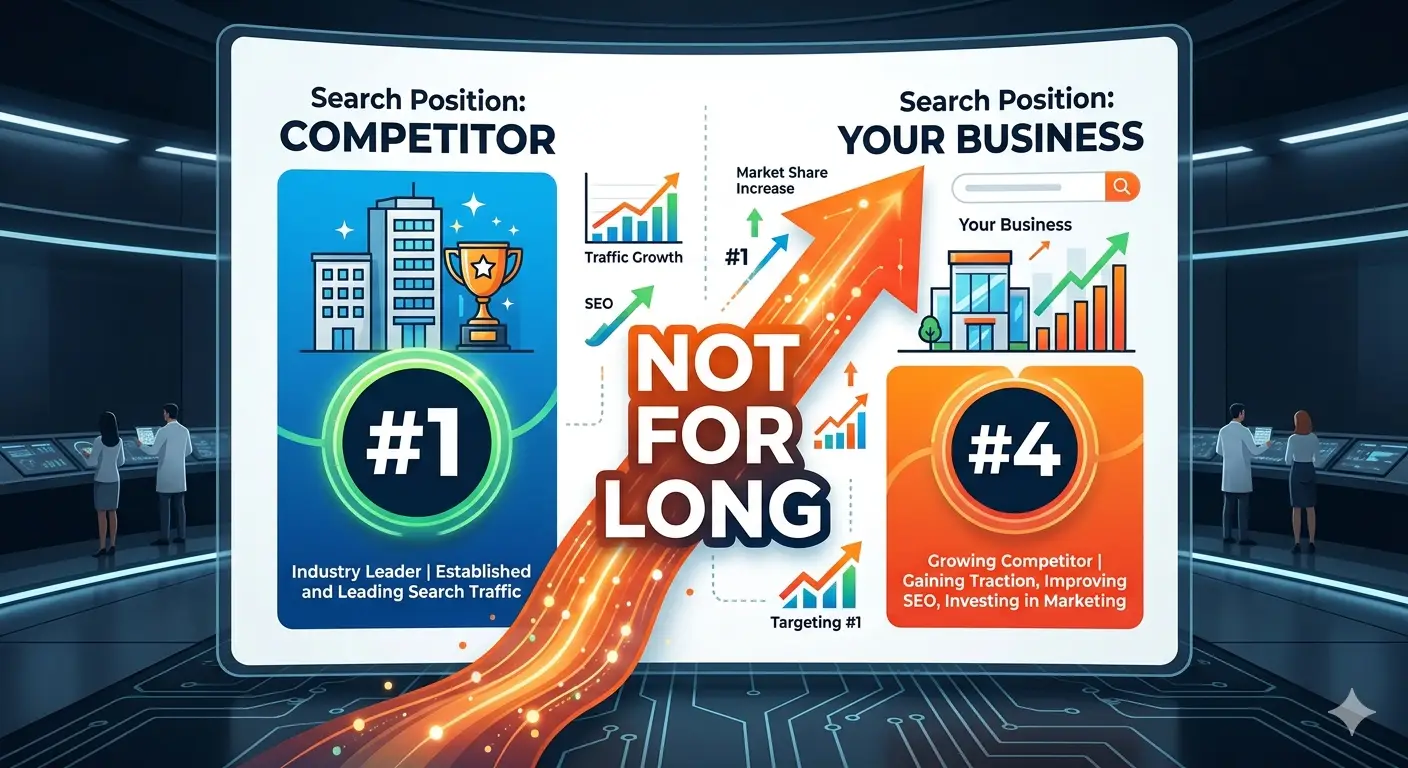
There are few things more frustrating in business than watching a competitor rank above you on Google — especially when you know your work is better, your service is stronger, and your clients are happier than theirs. The ranking feels arbitrary, unfair, even personal. It isn’t any of those things. Google ranks pages based on a set of measurable signals, and your competitor is above you because they’re currently winning on more of them. This guide explains exactly which signals matter, why your competitor is likely outperforming you on them, and what you can do to close the gap systematically.
First: Understand What Google Is Actually Measuring
Before diagnosing the gap, it helps to understand what Google is trying to do. Google’s goal is to show the most relevant, trustworthy, and useful result for any given search query. The algorithm that determines which pages appear in which order is essentially a proxy for answering: “Which of these businesses is most likely to give this person what they’re looking for?”
The signals Google uses to answer that question fall into three broad categories:
Authority — how trustworthy and credible does the wider web consider this website to be? Primarily measured through the quality and quantity of other websites linking to it.
Relevance — how well does this page actually address the search query? Measured through content quality, keyword use, page structure, and topical depth.
Experience — how good is the experience of visiting this website? Measured through page speed, mobile usability, security, and low bounce rates.
For local searches, a fourth category applies:
Local signals — how clearly does this business establish its presence in the relevant geographic area? Measured through Google Business Profile, local citations, reviews, and location signals on the website.
Your competitor ranks higher because they’re currently winning on more of these signals than you are. Let’s look at the specific reasons this happens.
Reason 1: Their Website Has More Authoritative Backlinks
The most significant and most frequently misunderstood ranking factor in SEO. A backlink is a link from another website to yours — essentially a vote of confidence from one site to another. Google treats links from credible, relevant, established websites as indicators of trust and authority.
If your competitor has been operating longer, has featured in industry publications, has earned links from local news sites, has appeared on podcasts, or has cultivated relationships with complementary businesses who link to them — their domain authority is higher than yours. This is not something you can overcome quickly, but it is something you can close over time.
What to do: Identify where your competitor’s links are coming from using a free tool like Ahrefs Webmaster Tools or Moz Link Explorer. Look for patterns — local directories, industry associations, press features, guest posts. Pursue the same categories of links for your own domain. Each credible link builds authority incrementally.
Reason 2: Their Content Answers the Question More Thoroughly
Google’s content quality signals have become increasingly sophisticated. For any given search query, Google assesses which page provides the most complete, accurate, and useful answer — not just which page contains the keyword most often.
If your competitor has a detailed service page, a comprehensive FAQ section, and a library of blog posts covering the topic from multiple angles — while your service page has three paragraphs and no supporting content — Google has more evidence that they’re the authority on the topic.
What to do: Search for your target keywords and open the pages that rank above yours. Read them properly. Ask: what do they cover that I don’t? What questions do they answer that my page ignores? What depth of information do they provide that mine doesn’t? Then improve your page — and build supporting content around it.
Reason 3: Their Website Is Technically Healthier
Technical SEO — the infrastructure underlying how your website is built and delivered — is less glamorous than content but equally impactful. Google explicitly factors in page speed, mobile usability, HTTPS security, crawlability, and site architecture when determining rankings.
A competitor whose website loads in 1.8 seconds on mobile, has no broken links, uses structured data correctly, and has a clean sitemap will outrank a technically identical competitor whose site takes 6 seconds to load and throws crawl errors — all other signals being equal.
What to do: Run your website through Google’s PageSpeed Insights (pagespeed.web.dev) and Google Search Console (free). Both will identify specific technical issues ranked by severity. Address the highest-impact issues first: speed, mobile usability, and any crawl errors.
Reason 4: Their Google Business Profile Is More Complete and More Active
For local searches — anything with a geographic modifier or near-me intent — Google Business Profile is a primary ranking signal. A fully completed, actively managed GBP significantly outperforms a partially completed or neglected one.
If your competitor has: a more specific primary category, more secondary categories, more photos uploaded recently, a higher volume of reviews, more recent reviews, regular posts, a complete service listing, and consistent NAP information across the web — their local ranking signals are stronger than yours.
What to do: Open your GBP dashboard and audit every section against the checklist in our complete Google Business Profile guide. Then open your competitor’s GBP (search for their business name) and compare. The gap you see is your priority list.
Reason 5: They’ve Been Publishing Content Consistently for Longer
Domain age and publishing history matter. A website that has been consistently publishing relevant, quality content for three years has accumulated more indexed pages, more topical signals, more backlinks, and more trust signals than one that began six months ago — regardless of how good the newer content is.
This is one of the most frustrating ranking gaps to face, because there’s no shortcut. You cannot compress three years of consistent publishing into three months.
What to do: Start publishing — and commit to consistency. One quality post per week, every week, compounds significantly over 12–24 months. The businesses that are hardest to displace from top positions are the ones that simply started earlier and never stopped. The second-best time to start is now.
Reason 6: They Have More Reviews — and More Recent Ones
For local search in particular, Google reviews are a powerful ranking signal — and one that many businesses systematically neglect. Google looks at total review count, average rating, and crucially, the recency of reviews. A business with 45 reviews spread over three years, with the most recent from eight months ago, is at a disadvantage compared to a competitor with 28 reviews and three in the last month.
What to do: Build a consistent review generation habit — one personal request to a satisfied client every week. Share the direct link to your Google review page. Respond to every review you receive. Within six months, a consistent habit produces a meaningful volume of recent reviews that builds ranking momentum.
Reason 7: Their On-Page SEO Is Better Structured
On-page SEO — the way individual pages are structured to communicate their relevance to Google — includes: the title tag, meta description, H1 heading, subheadings, keyword placement, internal linking structure, image alt text, and schema markup. These are entirely within your control to improve, and they’re often the quickest wins available.
Many small business websites have generic title tags (“Home | Business Name”), missing meta descriptions, H1 headings that say “Welcome” rather than the primary keyword, no internal links between related pages, and no schema markup. Each of these is a missed signal.
What to do: Install Yoast SEO or RankMath (both free). For each key page, ensure the title tag includes the primary keyword and location, the meta description is written for clicks, the H1 heading targets the keyword, and the content uses natural variations of the target phrase throughout.
The Honest Truth About Overtaking a Competitor
Here it is plainly: if your competitor has a three-year head start on content, a strong backlink profile, and an active local presence — you will not overtake them in three months.
SEO is not a sprint. The businesses at the top of competitive local search results are there because they’ve been building signals consistently over time. Overtaking them requires building those same signals — and doing so more consistently, more thoroughly, or more intelligently than they have.
The realistic timeline for meaningful ranking improvement:
- Technical fixes and on-page optimisation: 4–8 weeks for Google to reflect changes
- Google Business Profile optimisation: 4–8 weeks for local map pack improvement
- Content strategy: 3–6 months for new content to gain meaningful traction
- Backlink building: 6–12+ months for authority gains to reflect in rankings
- Overtaking an established competitor on competitive keywords: typically 12–24 months of sustained effort
This isn’t discouraging — it’s clarifying. Understanding the timeline helps you prioritise the right signals at the right time, and commit to the consistency that produces compounding results.
The 5-Minute Competitor SEO Audit
Before building your strategy, spend five minutes doing this:
- Search your main service keyword + your city. Note exactly who ranks above you and in what positions — both in the map pack and organic results.
- Open your competitor’s website. Check their title tag (visible in the browser tab), their H1 heading, and how much content is on their main service page.
- Open their Google Business Profile. Count their reviews. Check when the most recent one was posted. Look at how many photos they have.
- Search their business name on Yell.com. Check whether their NAP information is consistent with their GBP.
- Note one thing they’re doing that you aren’t. Start there.
This five-minute audit won’t tell you everything — but it will tell you the most impactful thing to address first.
Frequently Asked Questions
Why does my competitor rank higher than me on Google? The most common reasons are: they have more backlinks from credible websites; their content answers the search query more thoroughly; their website is technically faster and healthier; their Google Business Profile is more complete and more actively managed; they’ve been publishing relevant content consistently for longer; they have more and more recent Google reviews; and their on-page SEO signals (title tags, headings, structured data) are better optimised. Usually it’s a combination of several of these rather than one single factor.
How long does it take to outrank a competitor on Google? It depends on how established the competitor is and how competitive the keyword. For local searches in moderately competitive markets, meaningful improvement typically takes 3–6 months of consistent effort. Overtaking a competitor with significant domain authority and a long content history on competitive keywords typically takes 12–24 months of sustained SEO work. Technical fixes and GBP optimisation tend to show results fastest.
Can I outrank a competitor with a bigger website? Yes — website size alone doesn’t determine rankings. Relevance, content quality, user experience, and local signals can all allow a smaller, well-optimised website to outrank a larger but poorly structured competitor. Particularly in local search, a business with a better-optimised GBP, more recent reviews, and better local citations can outrank larger competitors who have neglected those signals.
What is the fastest way to improve my Google ranking? The fastest genuine improvements typically come from: fixing technical SEO issues identified in Google Search Console; optimising title tags and meta descriptions on key pages; completing and activating every section of your Google Business Profile; building NAP consistency across the main UK directories; and generating a batch of new Google reviews from recent satisfied clients. None of these is instant, but all can show meaningful results within 4–8 weeks.
Should I try to copy exactly what my top-ranking competitor is doing? Understanding what signals they’re winning on is valuable — it tells you what to prioritise. But copying their content directly is counterproductive (Google penalises duplicate content) and their strategy may not be perfectly optimised anyway. Use competitor analysis to identify gaps in your own signals, not as a template to replicate wholesale.
Do I need an SEO agency to outrank my competitors? Not necessarily — many of the most impactful improvements are achievable without specialist help, particularly on-page SEO, GBP optimisation, and review generation. Technical SEO, backlink building, and competitive keyword strategy benefit significantly from professional input. The right approach depends on how competitive your target keywords are and how quickly you need results.
Final Thought
Your competitor’s ranking isn’t a judgement on the quality of your business. It’s a reflection of their accumulated signals at this moment in time. Those signals are built — and they can be overtaken.
The businesses that climb consistently in search rankings are not the ones with the biggest budgets or the most sophisticated strategies. They’re the ones that identify the right signals, build them systematically, and maintain the consistency to compound them over time.
At HusQuay, closing competitor ranking gaps is one of the core outcomes we deliver — through technical SEO audits, content strategy, GBP management, and local citation building. If you’re tired of watching a competitor rank above you, let’s look at exactly what’s driving it and build the plan to overtake them.
👉 Book a free SEO competitor audit with HusQuay
HusQuay is a digital growth agency helping small businesses across the UK, USA, Australia, and Canada build websites, brands, and digital systems that create measurable results. Based in Wolverhampton, UK.