
“How long will it take?” is one of the first questions any business owner asks when starting a website project — and one of the most consistently poorly answered. Vague responses like “it depends” or suspiciously precise promises like “we’ll have it live in a week” are both warning signs. The honest answer is that timeline is determined by a specific set of factors, most of which are knowable in advance, and that the biggest cause of delay is almost never the agency — it’s content readiness on the client side. Here’s the real timeline breakdown, what drives it, and what you can do to keep your project on track.
The Honest Timeline by Project Type
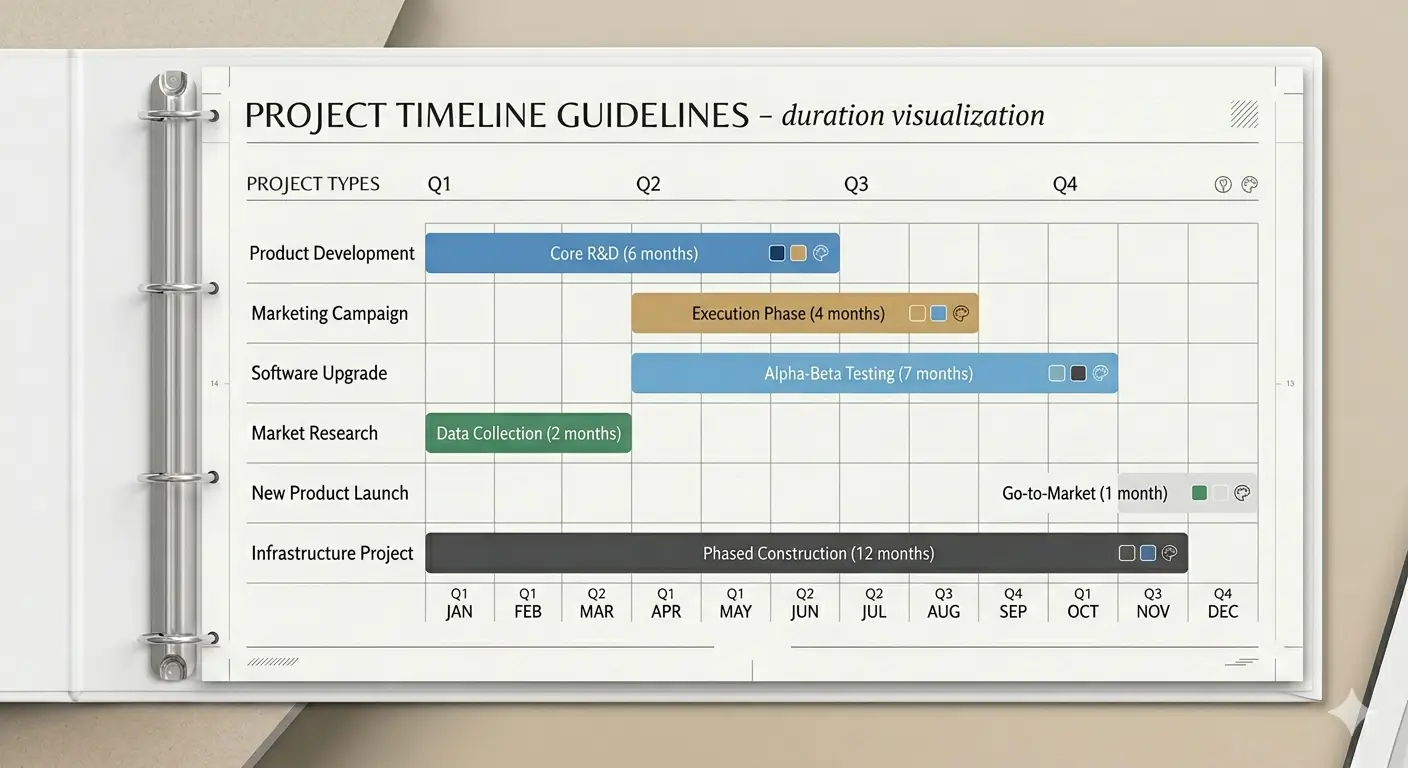
Let’s start with the numbers most people want first. These are realistic timelines for professional builds — not the fastest possible, not padded estimates, but the ranges you should expect when working with a competent agency or developer who is building properly rather than rushing.
Simple brochure website (3–5 pages): 2–4 weeks Home, About, Services, Contact — and perhaps one additional page. Clean design, standard functionality, no e-commerce, no complex integrations. This is the realistic minimum for a professional result. Claims of “live in 48 hours” at this level typically involve a template with your logo dropped in, not a genuinely built site.
Business website with blog and SEO (6–12 pages): 4–8 weeks A full online presence with service pages, a blog section, lead generation features, on-page SEO setup, and integration with your tools. This is the most common project type for growing small businesses and the range reflects variation in design complexity, number of integrations, and content readiness.
E-commerce website (up to 50 products): 8–16 weeks Product catalogue, shopping cart, payment gateway integration, order management, customer accounts, and all the testing that complex transactional functionality requires. E-commerce projects consistently take longer than clients initially expect because the testing phase alone — covering edge cases in payment flows, mobile checkout, and inventory management — adds significant time.
Custom web application: 3–6 months minimum A bespoke digital product — a client portal, a booking engine, a marketplace, a SaaS interface — built from the ground up. This is software development, not website building, and the timeline reflects that distinction.
The Six Phases of a Website Build
Understanding what actually happens during a website project makes the timeline more predictable and helps identify where delays typically occur.
Phase 1: Discovery and Planning (1–2 weeks)
The phase most clients wish they could skip and most experienced agencies insist on. This is where the scope is defined, the sitemap is agreed, the design direction is established, integrations are scoped, and the content plan is laid out.
Skipping this phase — jumping straight to design — almost always produces a longer project overall, because decisions that should have been made in week one get made (and remade) in week four when changing them is significantly more disruptive.
What causes delays here: Unclear brief, difficulty reaching decision-makers for sign-off, disagreement within the client organisation about direction.
Phase 2: Design (1–3 weeks)
Wireframes or full design mockups — depending on the agency’s process — showing how the site will look and how users will navigate through it. Most agencies present two to three design directions for key pages (homepage, inner page), then refine based on feedback before building begins.
What causes delays here: Slow feedback, repeated change of direction, requesting significant changes after sign-off on the initial direction, too many decision-makers in the approval process.
Phase 3: Development (2–6 weeks)
The build phase — converting approved designs into a working website. This is where the pages are built, the CMS is configured, the functionality is implemented, and the integrations are connected. The range reflects the difference between a simple five-page build and a complex twelve-page site with multiple integrations.
What causes delays here: Scope creep (adding features that weren’t in the original brief), dependencies on third-party tools that behave unexpectedly, technical issues with the hosting environment.
Phase 4: Content Population (1–3 weeks)
The most consistently underestimated phase — and the single most common cause of website projects running over time. Content includes all the text, images, videos, and downloadable files that go on every page of the site. If a client hasn’t prepared this before the build begins, the development team is either waiting for content before they can complete pages, or building with placeholder content that then needs to be swapped out later — which is slower and more error-prone than populating content correctly the first time.
What causes delays here: Content not prepared in advance, content arriving piecemeal over weeks rather than in one organised delivery, needing to create or commission photography or video during the project.
Phase 5: Testing and QA (1–2 weeks)
Every page on every device, every form, every link, every integration — tested systematically before anything goes live. For e-commerce projects this phase is significantly longer due to the complexity of payment and order flows. For simpler sites it can overlap with content population.
What causes delays here: Issues discovered late that require design or development changes, third-party integrations behaving differently in production than in staging.
Phase 6: Launch and Post-Launch (3–7 days)
Domain transfer, DNS changes, final checks, and the soft launch period where the site is live but being monitored closely for any issues that only appear in a live environment. Most agencies include a post-launch support period for minor fixes.
What causes delays here: DNS propagation (typically 24–48 hours), hosting setup complications, final content changes requested just before go-live.
What Actually Determines Your Timeline
Beyond the project type, four specific factors have the most influence on how long your project takes.
Content readiness. This is the single biggest variable in website project timelines — and it’s almost entirely in the client’s control. Businesses that arrive at the project kickoff with all text written, all images selected or commissioned, and all assets organised consistently deliver projects on time. Businesses that treat content as something to figure out once the design is done consistently cause delays of two to four weeks or more.
Feedback speed and decisiveness. Every revision round requires the client to review what’s been built and provide clear, consolidated feedback. Agencies that receive feedback within 48 hours of each review request can maintain momentum. Agencies waiting two weeks between feedback rounds lose the rhythm of the project and effectively double the calendar duration.
Scope clarity. Features added mid-project — “actually, can we also add a booking system?” or “we’d like to add five more service pages” — extend timelines proportionally. Every addition after the initial scope is agreed requires replanning, which disrupts the build schedule. Not all scope changes are avoidable, but unplanned ones always add time.
Agency capacity. A good agency is busy. A project starting in their quietest month will often move faster than the same project starting when they’re at full capacity. It’s worth asking specifically when your project would be resourced and whether the timeline accounts for their current workload.
Can It Be Done Faster?
Yes — but with trade-offs that are worth understanding.
An experienced developer can build a simple site in a week if the design is template-based, the content is fully prepared, and there’s no discovery phase. Whether the result is what a professionally built, conversion-optimised, SEO-ready site looks like is a different question.
Rush fees are real and justified. If you need a site built in half the standard timeline, you need the agency to prioritise your project above others — which has a cost. Legitimate agencies will tell you this. One that offers to rush a complex project for the same price as a normal timeline either isn’t as busy as you’d want them to be, or is cutting corners somewhere.
Red Flags in a Website Timeline
“We can have it live by the end of the week.” Unless you’re buying a template install with your logo, this timeline produces websites that look the part but perform poorly — lacking the SEO setup, the conversion optimisation, and the quality content that make a website generate business.
No discovery phase. An agency that jumps straight to design without understanding your business, your audience, your goals, and your content is building something they haven’t properly designed to perform.
No content discussion. If an agency never asks about your content — who’s writing it, when it’ll be ready, what assets you have — they’re either planning to build with placeholder content (which extends the project) or they haven’t thought through the process properly.
A very precise timeline on a complex project. A brochure site in three weeks is plausible. An e-commerce build in three weeks is a red flag. Complex projects have too many variables to promise with precision.
How to Keep Your Project on Schedule
The most impactful things a client can do to keep a website project on track:
Prepare your content before kickoff. Write all the text for every page before the project begins. Gather and organise all the images you want to use. Have any photography or video commissioned and delivered before the build starts.
Nominate one decision-maker. The most efficient website projects have a single person on the client side who reviews work, consolidates feedback from other stakeholders, and provides clear sign-off decisions. Projects with multiple approvers and no clear decision-maker are consistently the slowest.
Consolidate feedback. Provide all feedback on each review in one round, not in a series of emails over several days. Scattered feedback creates version control problems and slows the development team.
Agree the scope before signing. Any feature not in the original scope will extend the timeline. Identify everything you want in the initial brief — not mid-project.
Frequently Asked Questions
How long does it take to build a small business website? A simple 3–5 page brochure website from a professional agency typically takes 2–4 weeks. A more comprehensive business website with a blog, SEO setup, and multiple service pages takes 4–8 weeks. E-commerce websites typically take 8–16 weeks depending on product volume and complexity. Custom web applications take 3–6 months minimum.
What is the most common cause of website project delays? Content readiness is by far the most common cause of delays. When clients haven’t prepared their written content, images, and assets before the project begins, the development team is either waiting or building with placeholders — both of which extend the timeline significantly. Slow feedback and mid-project scope changes are the other leading causes.
Can a website be built in a week? A basic template-based website can be installed and configured in a week. A professionally built, SEO-ready, conversion-optimised business website cannot be delivered to a professional standard in a week, regardless of the agency’s capacity. Claims to the contrary typically indicate a template install with minimal customisation.
What is the fastest way to speed up a website project? Have your content fully prepared before the project starts, nominate a single decision-maker to handle feedback and approvals, and provide consolidated feedback quickly at each review stage. These three client-side actions have more impact on timeline than almost anything the agency can do.
Does a more expensive website take longer to build? Not necessarily — price reflects scope, complexity, and the seniority of the team working on it. A simple site built by a senior team may cost more than the same site built by a junior freelancer but take a similar amount of time. A complex e-commerce site costs more than a brochure site and takes longer because the scope is genuinely larger — but the relationship is between complexity and timeline, not price and timeline.
What happens if the project runs over time? Reputable agencies communicate proactively when timelines are at risk — and explain why. The most common reasons are client-side: late content delivery, slow feedback, or scope changes. Agency-side delays (unexpected technical issues, resourcing problems) happen but should be communicated immediately with a revised plan. A contract should specify what happens in the event of delays on either side.
Final Thought
A website project takes as long as it needs to take to be built properly. Rushing a complex project produces a site that looks complete but performs poorly — generating fewer enquiries, ranking lower in search, and requiring expensive remediation within 12–18 months.
The businesses that get the best results from their website investment are the ones that approach the project properly — with clear content, clear decisions, and realistic expectations — and work with an agency that builds with performance in mind, not just delivery speed.
At HusQuay, we’re transparent about timelines from the first conversation — because a realistic schedule is the foundation of a project that delivers what it promises. If you’re planning a new website and want to understand exactly what’s involved, start with a conversation.
👉 Book a free website consultation with HusQuay
HusQuay is a digital growth agency helping small businesses across the UK, USA, Australia, and Canada build websites, brands, and digital systems that create measurable results. Based in Wolverhampton, UK.