
Most conversations about AI in business are still focused on chatbots and automation triggers — useful tools that respond to prompts or fire when conditions are met. AI agents are something meaningfully different. Given a goal, an AI agent plans the steps required to reach it, executes those steps using the tools available to it, adapts when something unexpected happens, and delivers a completed outcome — without being prompted for each individual action along the way. This distinction is not technical nuance. It’s the difference between a tool that makes you faster and a system that handles work while you focus elsewhere.
What Actually Is an AI Agent?
The term gets used loosely — sometimes interchangeably with chatbot or automation — but the distinction is important enough to define precisely.
A chatbot responds to a question. You ask, it answers. One input, one output. It does nothing without a prompt.
An AI workflow automation fires when a trigger occurs and executes a predefined sequence. A form is submitted → contact is added to CRM → welcome email is sent. The sequence is fixed; the system follows it every time.
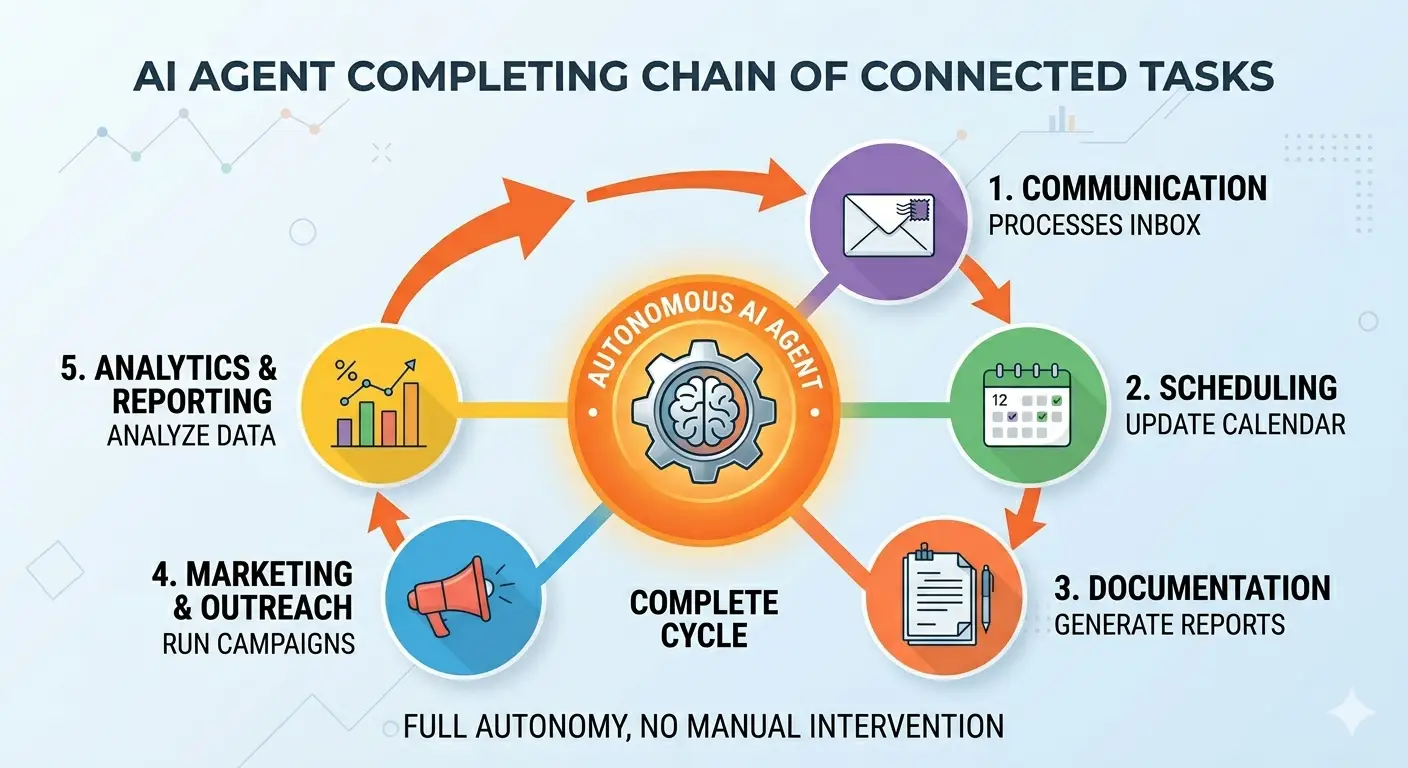
An AI agent is given a goal and figures out how to achieve it. It can use tools — search the web, read emails, write to a CRM, send messages, create documents, run calculations — and it sequences those actions based on what it finds along the way, not based on a fixed rule someone wrote in advance.
The practical implication: AI agents can handle tasks that are too variable, too multi-step, or too context-dependent for traditional automation — because they can think through the task rather than just execute it.
The Admin Tax on Service Businesses
Before looking at what AI agents can do, it’s worth quantifying what they’re replacing.
The average professional in a service business — a consultant, an agency team member, a legal or financial professional — spends between 30% and 40% of their working week on administrative tasks that are not their core skill. Email management, scheduling, research, data entry, report writing, chasing information, populating documents, updating systems.
At a billing rate of £75/hour, 40% of a 40-hour week is £1,200 of weekly capacity consumed by admin. Across a team of five, that’s £6,000 per week — or £312,000 per year — of capacity that isn’t generating revenue, delivering client value, or building the business.
AI agents don’t eliminate this entirely. But they can recover a meaningful portion of it — the portion that involves gathering information, synthesising it, and taking defined actions based on what they find. Which is most of it.
The Admin Tasks AI Agents Are Replacing Right Now
Pre-Call Research
Before a sales call or client meeting, someone typically spends 20–30 minutes researching the company — checking their website, LinkedIn, recent news, social presence, and any previous interactions — then summarising it into a brief.
An AI agent given the meeting attendee’s name and company will execute this research autonomously: scraping the web, checking LinkedIn, reading recent press releases, pulling previous email threads from your inbox, and producing a structured briefing document — in under five minutes, every time, without being asked to do it step by step.
Inbox Triage and Response Drafting
A senior professional’s inbox receives hundreds of emails per week. Sorting them, prioritising them, identifying which require an urgent response, which can wait, which are newsletter noise, and which need to be routed to someone else — then drafting appropriate responses — consumes hours.
An AI email agent monitors the inbox continuously, categorises incoming emails by urgency and type, drafts personalised responses for review, routes enquiries to the right person with context already summarised, and handles the unsubscribes and acknowledgements automatically. The human reviews and approves the drafts that need their voice; everything else is handled.
Lead Enrichment and Qualification
When a new enquiry lands — via form, email, or LinkedIn message — a team member typically spends 15–20 minutes researching who the prospect is, what their business does, whether they fit the target client profile, and what their likely budget might be, before deciding how to prioritise the response.
An AI agent can do this in seconds: cross-referencing the prospect’s name and company against LinkedIn, Companies House, their website, and any previous contact history, then populating the CRM with enriched data and a lead score — so the salesperson opens a fully briefed record rather than a blank entry.
Meeting Notes and Action Item Extraction
After every client call, someone writes up the meeting notes, identifies the action items, assigns them to the relevant people, updates the project management tool, and sends a follow-up email summarising what was discussed and what happens next. For a team running ten client calls per week, this is three to five hours of administration.
An AI agent joins the call via a tool like Fireflies.ai or Otter.ai, transcribes in real time, identifies decisions and action items, assigns them to the correct people in your project management tool, drafts the follow-up email, and sends it for review — within minutes of the call ending.
Weekly Reporting
Every Monday, someone pulls data from the CRM, the analytics platform, the ads dashboard, the accounting tool, and whatever other systems the business uses — compiles it, calculates week-on-week changes, and writes a summary. For a business tracking five data sources, this takes 60–90 minutes.
An AI reporting agent runs at a scheduled time, connects to each data source via API, pulls the defined metrics, identifies notable trends and anomalies, and writes a plain-English summary that lands in the relevant Slack channel before the team sits down. The humans discuss the content; nobody spent time compiling it.
Document and Proposal Drafting
Given a brief — client name, scope, budget, timeline — an AI agent can draft the first version of a proposal or scope document by pulling from previous proposals, populating standard sections, adapting the language to the client’s industry, and formatting it according to the template. A human reviews, refines, and adds the judgements only they can make. The 90-minute task becomes a 20-minute task.
What Makes AI Agents Different From Earlier Automation
Earlier automation tools — Zapier, Make, scheduled scripts — execute predefined sequences. They’re fast, reliable, and excellent for predictable tasks. They break when anything falls outside the sequence they were built for.
AI agents handle variability. They read context, make judgements, and adapt. An AI agent researching a prospect doesn’t follow a fixed script — it decides which sources to check based on what it finds, synthesises information that arrives in unstructured formats, and produces an output appropriate to the specific situation.
This makes AI agents suitable for the tasks that have always required a human precisely because they required judgement — not because they were technically complex.
What AI Agents Can’t Do
Honest disclosure matters here.
AI agents make mistakes. They misread context, hallucinate facts they can’t verify, produce outputs that sound confident but are wrong. Any agent operating autonomously — without human review of its outputs — carries this risk, and it’s a risk that needs to be managed rather than ignored.
The right model for most business applications is human-in-the-loop: the AI agent handles the research, drafting, and execution, and a human reviews the key outputs before they go anywhere consequential. This captures 70–80% of the time saving while preserving the quality control that matters.
AI agents also can’t replace the distinctly human elements of business: the judgement built from deep experience, the relationship sensitivity of a difficult client conversation, the creative direction that comes from understanding what a brand stands for. These remain human work. The admin that surrounds them doesn’t have to be.
How to Start with AI Agents
The best starting point for most service businesses is one of the five tasks described above — chosen based on volume and time cost.
The practical path:
Step 1: Identify the highest-volume admin task in your business that involves gathering information and producing a document or action.
Step 2: Map exactly what a human does when they complete that task — every source they check, every decision they make, every output they produce.
Step 3: Choose the appropriate tool layer. For meeting notes: Fireflies.ai or Otter.ai. For inbox management: Superhuman, SaneBox, or a custom GPT-4 integration. For research and reporting: a custom build using the Anthropic or OpenAI API with web search enabled.
Step 4: Run the agent alongside the manual process for two to four weeks. Compare outputs. Identify where it performs well and where it needs refinement.
Step 5: Gradually reduce the manual parallel process as confidence in the agent builds.
Frequently Asked Questions
What is an AI agent? An AI agent is an autonomous AI system that can plan and execute a sequence of actions to achieve a defined goal, using tools such as web search, email access, CRM integration, and document creation. Unlike a chatbot that responds to individual prompts, an AI agent works toward an objective — deciding which steps to take and adapting based on what it finds — without being guided through each individual action.
How are AI agents different from AI chatbots? A chatbot responds to a single prompt and produces a single output. An AI agent is given a goal and autonomously plans and executes multiple actions to achieve it, using tools available to it — searching the web, reading emails, writing to databases, creating documents. The chatbot answers a question; the agent completes a task.
What admin tasks can AI agents handle for small businesses? The most common applications are: pre-call research and briefing, inbox triage and response drafting, lead enrichment and CRM population, meeting transcription and action item extraction, weekly reporting and data synthesis, and first-draft document and proposal creation. These tasks share the characteristic of being multi-step, information-gathering activities that produce a document or action as their output.
Do AI agents make mistakes? Yes — AI agents can misread context, make incorrect inferences, or produce outputs that sound confident but are factually wrong. For this reason, the recommended approach for most business applications is human-in-the-loop: the agent handles the research and drafting, and a human reviews key outputs before they go anywhere consequential. This captures most of the time saving while maintaining necessary quality control.
How much do AI agents cost for small businesses? The cost depends on the implementation approach. Existing tools with built-in agent capabilities — Fireflies.ai for meeting notes, HubSpot AI for CRM enrichment — typically add £20–£80/month to existing subscriptions. Custom-built agents using AI APIs cost £1,000–£5,000 to develop, plus API usage costs that are typically pennies per task. The return on investment is usually measured in weeks, not months.
Will AI agents replace human roles in service businesses? The current realistic impact is not job replacement but capacity expansion — recovering the 30–40% of professional time currently spent on administrative tasks, and redirecting it to higher-value work. Teams that implement AI agents effectively tend to do more with the same headcount rather than reduce headcount. Whether this changes over a longer horizon as agent capability grows is a genuine open question, but the immediate impact for most small businesses is freeing people to do the work they were hired to do.
Final Thought
The administrative burden on service business teams is real, measurable, and — for a growing proportion of it — no longer necessary to carry manually. AI agents represent the next layer of capability beyond the automation tools most businesses are only just beginning to adopt.
The businesses that implement them thoughtfully over the next 12–24 months will build a structural cost advantage that compounds over time: the same team, producing more, at a higher quality, with less friction. That advantage is available now, and it’s more accessible than most business owners realise.
At HusQuay, we design and deploy AI agent systems for service businesses — from pre-built solutions to fully custom implementations. If you want to understand what could be automated in your specific operation, that’s exactly the conversation to start.
👉 Book a free AI audit with the HusQuay team
HusQuay is a digital growth agency helping small businesses across the UK, USA, Australia, and Canada build websites, brands, and digital systems that create measurable results. Based in Wolverhampton, UK.