
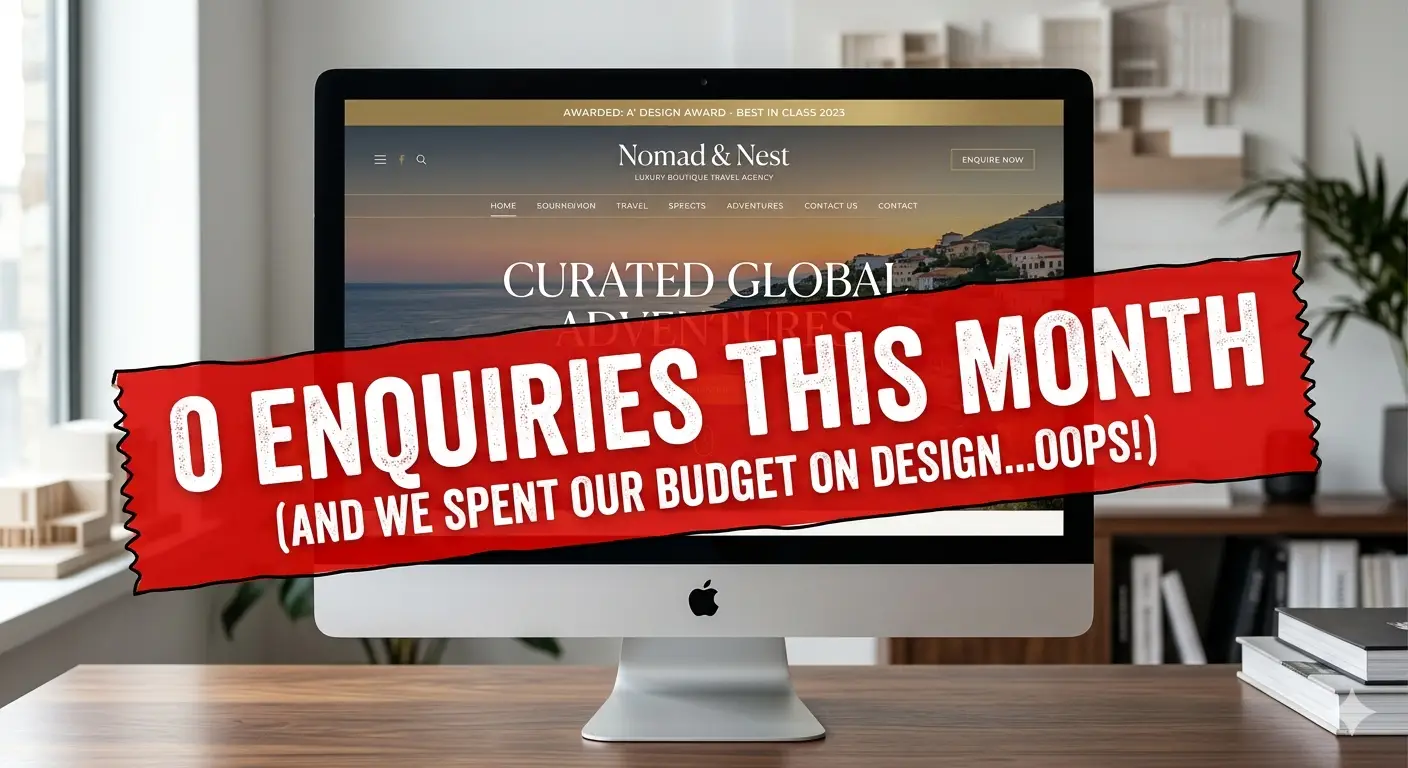
There is a particular irony in the digital agency world: the businesses best positioned to build websites that generate enquiries are often the ones with the worst-converting websites of their own. Not because they lack skill — their client work is frequently excellent. But because when agencies build their own website, they build it for the wrong audience. They build it to impress their peers, win awards, and demonstrate technical capability — rather than to convert the business owners who might hire them. This piece is an honest look at why that happens, what the specific mistakes are, and what a genuinely converting agency website actually does differently.
The Core Problem: Who Is This Website Actually For?
Every effective website is built for a specific person — the ideal potential client who lands on it, knows nothing about the business, and needs to be convinced, quickly and credibly, that they’re in the right place and that the business can solve their problem.
For most agency websites, that person is a business owner. Someone with limited time, a genuine problem they want solved, no particular interest in design trends or development frameworks, and a specific set of questions they need answered before they’ll consider making contact.
But agency websites are frequently built for a different audience entirely: other designers and developers. The people who will notice the custom cursor. Who will appreciate the scroll-triggered animations. Who will recognise the typographic choices. Who will nod at the clever navigation.
This audience is not the agency’s client. But it’s the audience most agency websites are optimised for — because it’s the audience the agency’s team is most aware of, most impressed by, and most likely to be judged by in award submissions and industry forums.
The result is websites that win design awards and generate no enquiries. Which is, in a business context, a failure.
The Specific Mistakes
Impressive Visuals, Unclear Value Proposition
Agency websites are frequently beautiful. They also frequently fail to answer, within five seconds, the questions every potential client is asking the moment they land: what do you do, who do you do it for, and why should I choose you over the fifteen other agencies I’ve already looked at today?
The full-screen video reel is striking. The ambient music is atmospheric. The loading animation is clever. But the business owner who arrived from a Google search for “web design agency for professional services firms” is now three seconds in, can’t find a headline, and is already wondering whether to go back to the search results.
Clarity converts. Beauty helps. In that order.
Portfolio Over Outcomes
Agency websites are dominated by portfolio sections — and portfolios are important. But the information most agencies lead with (what the thing looked like, which tools were used, how the design was approached) is not the information their ideal clients are most interested in.
Business owners buying agency services are not buying a beautiful website. They’re buying the outcomes a website produces: enquiries, revenue, search visibility, client trust. A portfolio that shows outcomes — measurable results the client achieved after the agency’s work — is dramatically more persuasive than one that shows pretty screenshots.
“We redesigned [company]’s website. Here’s how it looked.” — This is a portfolio.
“We redesigned [company]’s website. Within four months, organic traffic increased 180% and enquiries rose from 3 per month to 19.” — This is evidence. Evidence converts.
Agency-Centric Copy
The copy on most agency websites is written about the agency: our process, our team, our approach, our values, our awards. The client is mentioned as a recipient of all this — the lucky beneficiary of the agency’s considerable expertise.
Converting copy inverts this. It starts with the client’s problem, describes the world they’re trying to reach, and positions the agency as the means to get there. Not “we build beautiful, award-winning websites” but “businesses that invest in the right website stop competing on price and start competing on value.”
The first sentence of your website should be about the reader, not about you.
Clever Navigation That Confuses
Agencies love non-standard navigation. Hidden menus. Hamburger icons on desktop. Navigation that appears only on scroll. Labels that are conceptual rather than descriptive (“World” instead of “Case Studies,” “Thinking” instead of “Blog”).
For visitors who navigate websites professionally, this is interesting. For a business owner who arrived wanting to find the services page and the contact form, it’s friction. Friction costs conversions. The navigation should be boring, obvious, and instant.
Hiding the Process and Pricing
One of the most consistently effective conversion elements on a service business website is transparency about how the service works — what happens from first contact to delivery, and roughly what it costs.
Most agencies hide both. Pricing is “contact us for a quote.” Process is a vague list of buzzwords (“strategy, design, build, launch”). This forces potential clients to submit an enquiry before they have any idea whether the agency is even in their price range or operates the way they need.
Prospects who don’t know if they can afford you don’t enquire. They move on to an agency that tells them. Transparency about process and price range (not necessarily exact figures, but ballpark) dramatically increases the quality and volume of inbound enquiries.
Trying to Appeal to Everyone
“We work with businesses of all sizes, across every industry.” This sentence appears on hundreds of agency websites. It communicates nothing — and it signals to every specific type of client that they’re not particularly understood or catered for.
The agencies that generate the most consistent, highest-quality inbound enquiries have made a deliberate choice about who they serve: a specific sector, a specific scale of business, a specific type of problem. Their website speaks directly to that audience in their language. It demonstrates familiarity with their specific situation. It makes the ideal client feel immediately recognised.
Specificity narrows the pool of potential enquiries — and dramatically improves the quality of the ones that come in.
Weak or Missing Social Proof
Agency websites frequently display client logos. They less frequently display testimonials. They rarely display specific, quantified outcomes. And they almost never display testimonials from clients who sound like the ideal future client.
A logo from a well-known brand is impressive to other agencies. A testimonial from a business owner who sounds exactly like your target client — describing exactly the problem they had, exactly what working with the agency was like, and exactly what changed as a result — converts the next business owner who has the same problem.
Social proof is most powerful when it’s specific, relevant, and from someone who looks like the reader.
What a Converting Agency Website Does Differently
The agencies whose websites consistently generate enquiries — rather than industry admiration — have made different choices at every decision point.
They lead with a clear, client-centric headline that immediately communicates what they do and who for. They show outcomes alongside portfolio work, with named results wherever possible. They have a single, prominent call to action that asks the visitor to take one specific next step. Their navigation is conventional and obvious. They publish pricing context so the right clients self-select. They speak to a defined audience in that audience’s language. They put testimonials not on a separate page but alongside every key decision point on the page. And they make the enquiry process — booking a call, submitting a brief — frictionless.
None of these choices require sacrificing visual quality. The best agency websites are both beautiful and highly converting. The two are not in opposition — but when they appear to be, converting must win.
The Honest Self-Assessment for Agencies
If you run an agency, answer these questions about your own website:
Does your homepage headline answer, within five seconds, what you do and who for?
Do your portfolio case studies include specific, measurable outcomes — or just visual work?
Does your copy talk more about your client’s problem or your agency’s capabilities?
Can a new visitor find your services, your process, and a way to contact you within 30 seconds?
Do you have testimonials from clients who sound like your ideal future client — adjacent to your primary CTA?
Would a business owner who’d never heard of you, landing on your site from a Google search, know immediately whether you’re relevant to them?
For most agencies, the honest answer to several of these is no. Which is a valuable diagnosis — not a comfortable one, but an actionable one.
Frequently Asked Questions
Why do most agency websites fail to convert potential clients? The most common reason is that agency websites are built to impress industry peers rather than convert business owners. This produces sites that prioritise visual impact, technical complexity, and design trends over the clear value proposition, specific outcomes, and frictionless enquiry process that potential clients actually need to feel confident making contact.
What makes an agency website convert well? A converting agency website leads with a clear, client-centric headline; shows specific, measurable outcomes alongside portfolio work; has a single prominent call to action; uses conventional navigation; provides context on process and pricing; speaks to a defined target audience in their language; and places relevant testimonials adjacent to key decision points — not on a separate testimonials page.
Should an agency website show pricing? Not necessarily exact prices — but providing context on price range (starting from, typical investment, or simply “our projects start from £X”) significantly increases the quality and relevance of inbound enquiries. Prospects who don’t know if they can afford you tend not to enquire — they move to an agency that gives them enough information to self-qualify.
How important is portfolio work on an agency website? Important — but less important than most agencies assume, and significantly less important than the outcomes that portfolio work produced. A case study that shows a beautiful before-and-after alongside specific results (increased traffic, more enquiries, revenue growth) outperforms a case study that shows only the visual work. Business owners are buying outcomes, not aesthetics.
How do agency websites get enquiries from the right clients? By being specific about who they serve. Agencies that try to appeal to every type of business typically attract a broad, low-quality mix of enquiries. Agencies that define their ideal client — by sector, by size, by type of problem — and speak directly to that audience in their website copy attract fewer but far better-qualified enquiries, at a higher average project value.
Final Thought
There’s a version of this article that’s embarrassing to write, because it describes mistakes we’ve seen in our own early work and in the work of agencies we respect. The instinct to build something that makes your peers nod is genuine and understandable — it’s the feedback loop you live in every day.
But business owners aren’t your peers. They don’t care about the scroll behaviour. They care whether you understand their problem, whether you’ve solved it for someone like them before, and whether reaching out feels safe and easy.
The agencies that build websites around those questions — rather than around the questions their industry asks — are the ones that grow by inbound consistently, rather than relying on reputation and referrals alone.
At HusQuay, this is a tension we navigate consciously — building work that meets our own standards and converts the clients who’d benefit from it. If your agency website isn’t generating the enquiries your work deserves, let’s look at it together.
👉 Book a free website review with the HusQuay team
HusQuay is a digital growth agency helping small businesses across the UK, USA, Australia, and Canada build websites, brands, and digital systems that create measurable results. Based in Wolverhampton, UK.