
A new team member writes a proposal using a slightly different shade of blue. Your web developer uses the wrong font on the new landing page. The print shop produces business cards that look nothing like your website because nobody sent them the right files. A social media manager posts with a graphic that doesn’t feel quite like the brand — but nobody can articulate exactly why. All of these situations share a common cause, and a common solution. The cause is the absence of a brand style guide. The solution is creating one.
What Is a Brand Style Guide?
A brand style guide — also called brand guidelines or a brand manual — is a document that defines the rules for how your brand should be represented visually and verbally across every platform and medium it appears in.
It is, in essence, the instruction manual for your brand. It tells anyone who needs to produce work that represents your business — employees, designers, developers, printers, agencies, social media managers — exactly how to do so consistently and correctly.
Without one, every person who touches your brand makes their own interpretation. Some will get it mostly right. Some won’t. And over time, the cumulative effect of hundreds of small inconsistencies erodes the coherent brand identity you’ve invested in building.
What Does a Brand Style Guide Contain?
The scope of a brand style guide varies significantly — from a two-page “brand basics” document to a comprehensive 50-page manual for a complex organisation. For most small businesses, a thorough but focused guide covers the following core elements.
Logo Usage
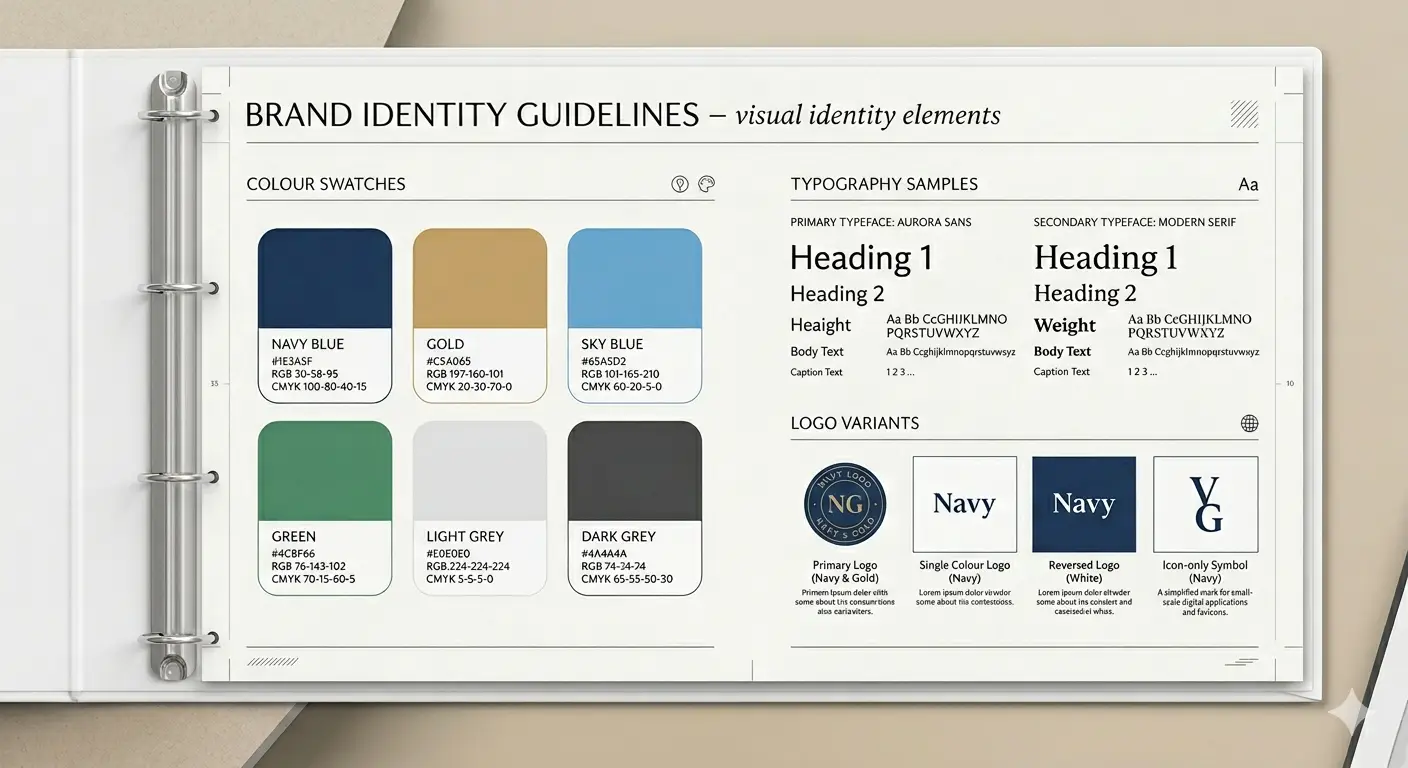
Rules for how the logo should and should not be used — in exhaustive, unambiguous detail. This includes: the approved logo variations (primary horizontal, stacked, icon only, reversed), the minimum sizes at which each version can be used, the required clear space (minimum white space) around the logo, the approved background colours the logo can appear on, and explicit examples of incorrect usage (stretched, recoloured, rotated, placed on clashing backgrounds).
This section prevents the logo from being distorted, misapplied, or used in contexts that undermine the brand. It is often the most immediately useful section for day-to-day brand management.
Colour Palette
The approved colour palette with technical specifications in every colour system it will be needed in. At minimum: HEX codes for digital use, RGB values for screen applications, CMYK values for print, and Pantone references for exact colour matching in professional production.
The guide should also specify the hierarchy of colours — which is the primary brand colour, which are secondary, which are accent colours — and any rules about how colours can be combined. A palette with six colours but no rules about how to use them together produces inconsistent, clashing output.
Typography
The approved typefaces for all use cases — headings, body text, captions, calls to action — along with the specific weights, sizes, and line spacing that constitute the brand’s typographic style. Where licensed fonts are used, the guide should specify how to obtain them and what free alternatives are acceptable if the licensed version isn’t available.
Typography is one of the most commonly drifted brand elements. Without documented rules, “the font that looks like the website one” becomes a different font with every new person involved.
Imagery and Photography Style
Guidelines on the type of photography, illustration, or graphic elements that represent the brand — and those that don’t. This might cover subject matter (real people vs stock images), mood (bright and energetic vs measured and professional), composition style, colour treatment, and what to avoid.
For businesses that produce a significant volume of visual content — social media, presentations, proposals — this section prevents the brand from visually fracturing across different channels.
Brand Voice and Tone
How the business communicates in writing — not just what it says but how it says it. This includes: the brand’s core personality traits (direct, warm, expert, accessible — whatever applies), the tone appropriate for different contexts (more formal in proposals, less formal on social), words and phrases that are characteristic of the brand, and words and phrases that are off-brand.
Voice and tone guidelines are particularly valuable as a business grows and more people write on its behalf. They ensure that the company’s emails, social posts, website copy, and proposals all feel like they come from the same organisation.
Usage Examples
A good brand style guide doesn’t just state rules — it shows them in context. Business card layouts, email signature templates, social media post templates, presentation slide designs, and letterhead examples all demonstrate how the brand elements work together in real applications. These examples are often more useful than the rules themselves, because they answer the question “what should this actually look like?” rather than requiring someone to interpret abstract guidelines.
What a Brand Style Guide Is Not
A brand style guide is not a marketing strategy. It doesn’t tell you what to say — it tells you how to say it and how to look while saying it.
It is not a logo file. The style guide references and displays the logo but doesn’t replace the actual logo files that need to be shared separately with anyone who needs to use them.
It is not a one-time exercise. A brand style guide should evolve as the business evolves — updated when new brand elements are added, when the visual identity is refreshed, or when new channels require new guidance.
And it is not an optional extra for businesses that have “got branding done.” The guide is what makes the branding work over time.
Does Your Small Business Actually Need One?
The honest answer for most businesses: yes. The question is what level of detail is appropriate for where you are.
If you are a sole trader or very early-stage business with no team and no external suppliers producing content on your behalf, a simple one-page brand basics document — logo files, colour codes, the font you use — is sufficient for now. You can create this yourself in under an hour and have something to share when it’s needed.
If you have a team, even a small one, and multiple people produce content that represents the business, a proper style guide is essential. The moment more than one person is writing emails, designing documents, or creating social content, inconsistency is inevitable without documented guidelines.
If you work with external suppliers — a web developer, a graphic designer, a social media agency, a print company, a PR firm — every one of them needs brand guidelines to do their job consistently with your existing identity. Without a guide, each will make their own interpretation. The cumulative effect is a brand that looks slightly different everywhere it appears.
If you’ve invested in a professional brand identity, the style guide protects that investment. A brand identity without guidelines is like buying an expensive car without a maintenance manual — the asset degrades without the reference documentation that keeps it working as intended.
When a Brand Style Guide Is Non-Negotiable
There are specific business situations where the absence of a style guide moves from a problem to a crisis:
Fundraising or seeking investment. Investors look at brand coherence as a proxy for operational competence. Inconsistent branding across touchpoints signals a business that hasn’t nailed the basics.
Taking on staff in marketing or communications. Without guidelines, new team members produce work based on personal interpretation. The longer this continues, the harder it becomes to return to a coherent identity.
Rebranding. When transitioning from an old brand to a new one, a style guide is the primary tool for managing the transition consistently across all touchpoints.
Franchise or multi-location businesses. Every location needs identical brand representation. This is only achievable with documented, enforced guidelines.
How Much Does a Brand Style Guide Cost?
When produced as part of a broader branding project, the style guide is typically included in the overall scope. Standalone style guide projects — starting from an existing logo and identity — typically cost £500–£2,000 depending on depth and scope.
For businesses not yet ready to commission a professional guide, a usable starting document can be created in-house: take your existing logo files, note down the exact colour codes (available from your original designer or by using a colour picker tool), document the fonts you use, and create a simple PDF with examples of correct usage. This takes a few hours and produces something significantly more useful than nothing.
Frequently Asked Questions
What is a brand style guide? A brand style guide is a document that defines the rules for how a brand should be represented visually and verbally — covering the logo, colour palette, typography, imagery style, and brand voice. It ensures that everyone who produces work on behalf of the business does so consistently, regardless of their role, department, or location.
What is the difference between a brand style guide and brand guidelines? They refer to the same thing. Brand style guide, brand guidelines, brand manual, and brand bible are all terms used for the same type of document — one that documents the rules governing how a brand is represented across all media and contexts.
Do small businesses need a brand style guide? Most small businesses benefit from having at least a basic brand reference document, even if it’s a simple one-page summary of logo files, colour codes, and fonts. As the business grows and more people and external suppliers become involved in producing branded content, a more comprehensive style guide becomes essential for maintaining consistency.
What should a brand style guide include? A comprehensive brand style guide typically includes: logo usage rules and approved variations, colour palette with full technical specifications (HEX, RGB, CMYK, Pantone), typography system with approved typefaces and usage rules, imagery and photography style guidelines, brand voice and tone guidelines, and examples of correctly applied brand elements across common use cases.
How long does it take to create a brand style guide? A comprehensive brand style guide created by a professional agency as part of a branding project typically takes two to four weeks to produce. A standalone style guide project for an existing brand typically takes one to two weeks. A basic in-house brand reference document can be produced in a few hours.
How much does a brand style guide cost in the UK? When produced as part of a broader branding project, guidelines are typically included in the overall project cost. A standalone brand style guide project — starting from an existing identity — typically costs £500–£2,000 in the UK depending on the depth, scope, and number of use-case examples included.
Final Thought
A brand style guide is not bureaucracy for its own sake. It is the practical mechanism through which a brand identity remains coherent, recognisable, and professional as the business grows, as new people come on board, and as the brand appears across an ever-wider range of platforms and contexts.
The businesses with the strongest brands — the ones that look consistently professional everywhere they appear — almost always have documented guidelines behind them. Not because they’re large enough to need them. Because they were smart enough to create them before the inconsistency became a problem.
At HusQuay, every brand identity project we deliver includes a comprehensive style guide as standard. If you have a brand identity but no guidelines to support it, we can create one — or we can start from scratch and build both together.
👉 Book a free brand consultation with the HusQuay team
HusQuay is a digital growth agency helping small businesses across the UK, USA, Australia, and Canada build websites, brands, and digital systems that create measurable results. Based in Wolverhampton, UK.