
When you’re building or rebuilding a business website, the platform decision feels like it should be straightforward — pick the best one and move on. In practice, it’s one of the most consequential choices you’ll make for your online presence, and the right answer genuinely differs depending on what your business needs, what your budget is, and how ambitious your growth plans are. This guide gives you an honest, platform-neutral comparison of Wix, WordPress, and custom-built websites — including the situations where each one is the right choice and the situations where choosing it would be a mistake.
Let’s be clear about what we’re actually comparing. There are hundreds of website platforms — Squarespace, Shopify, Webflow, Framer, and many others. But Wix, WordPress, and custom builds represent three fundamentally different approaches to building a business website, each with a distinct philosophy:
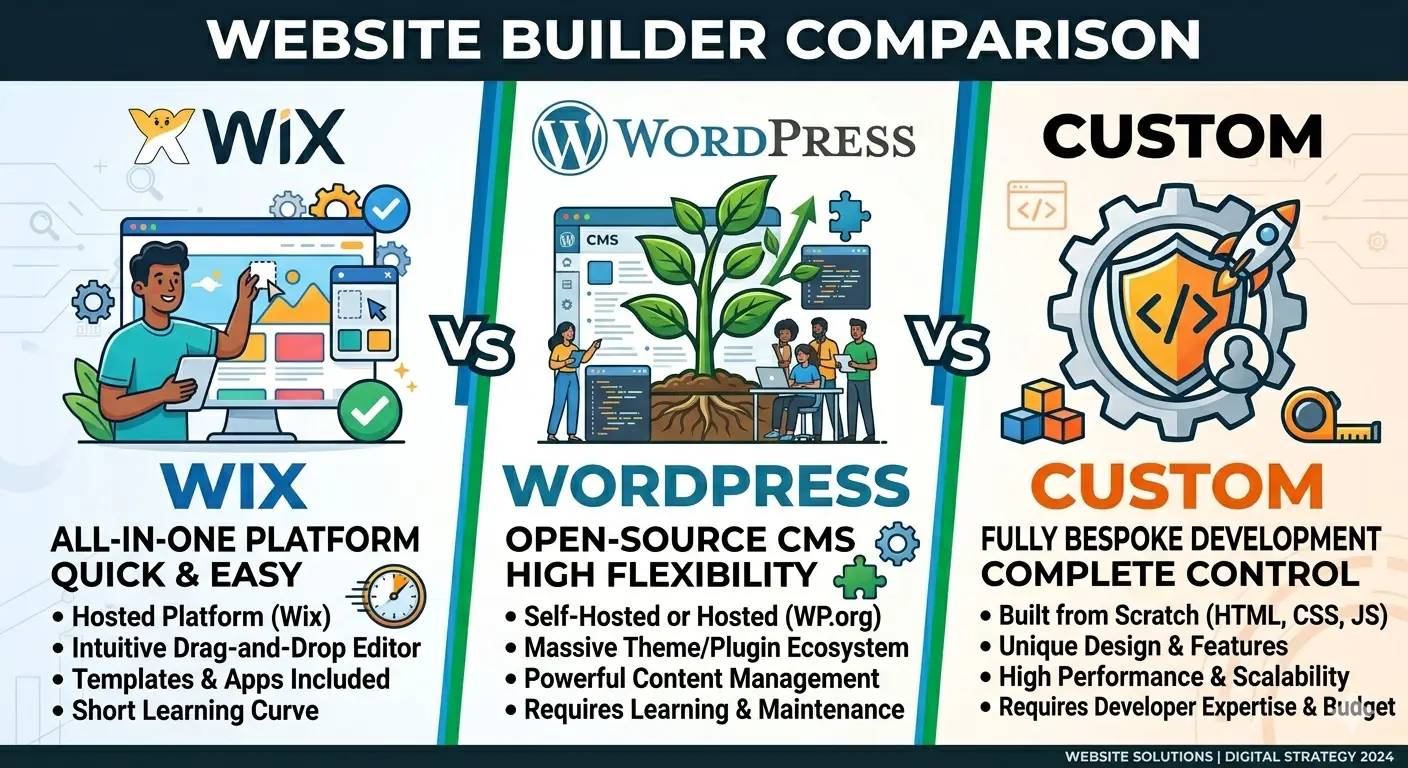
Wix — everything managed for you, in one place, with a visual drag-and-drop editor. WordPress — an open-source content management system you host yourself, customised with themes and plugins. Custom build — a website built from the ground up by a developer, without a template layer in between.
Understanding that difference in approach is more useful than comparing feature lists, because it tells you which philosophy fits how you work and what you need.
Wix: The Managed All-in-One Platform
Wix is a hosted website builder — meaning Wix handles your hosting, security, software updates, and technical infrastructure. You log in to a browser-based editor, drag and drop elements around a visual canvas, and publish without touching a line of code.
What Wix does well:
Speed to launch. A presentable Wix site can be live in a day or two, sometimes less. For a business that needs an online presence quickly without technical support, this is genuinely valuable.
Simplicity. The editing interface is visual and intuitive. Non-technical users can update content, add pages, and make changes without needing a developer.
All-in-one convenience. Hosting, domain management, SSL certificate, email, and basic analytics are all available within one platform and one subscription.
Where Wix falls short:
Performance and SEO ceilings. Wix has improved its SEO capabilities significantly over the past few years, but it still generates heavier code than a well-optimised WordPress or custom site. Page speed — particularly on mobile — is harder to optimise, and speed is a ranking factor. For businesses that need to rank competitively, this is a material limitation.
Limited flexibility. Wix’s visual editor is powerful within its constraints, but those constraints are real. Custom layouts, complex functionality, and non-standard integrations often hit walls that require workarounds or simply aren’t achievable.
Platform dependency. Your website exists on Wix’s infrastructure. If Wix changes its pricing, discontinues a feature, or — in an extreme scenario — closes, your options are limited. Migration away from Wix is significantly harder than moving between self-hosted platforms.
Template aesthetic risk. Wix templates are widely used. Without significant customisation, Wix sites can look similar to thousands of others — which is a brand differentiation problem for businesses trying to stand out.
Best for: Pre-revenue or very early-stage businesses that need a basic online presence quickly, at minimal cost, without technical support. Not recommended for businesses where website performance, SEO, or bespoke functionality are priorities.
WordPress: The Flexible Open-Source CMS
A critical distinction first: WordPress.com (the hosted service, similar in model to Wix) and WordPress.org (the open-source software you download and install on your own hosting) are meaningfully different products. When professionals refer to “WordPress,” they almost always mean WordPress.org — the self-hosted version. That’s what this section covers.
WordPress.org powers approximately 43% of all websites on the internet. It is the world’s most widely used content management system by a significant margin, and for good reason.
What WordPress does well:
Flexibility. With tens of thousands of themes and plugins available — and the ability for developers to build custom functionality on top — WordPress can do almost anything a website needs to do. It’s the foundation for everything from simple brochure sites to complex e-commerce operations to membership platforms.
SEO performance. WordPress, properly configured with plugins like Yoast or RankMath and hosted on quality infrastructure, is an excellent SEO platform. Full control over site structure, URL patterns, meta data, schema markup, and page speed optimisation is available to developers who know what they’re doing.
Content management. WordPress was built as a blogging platform and remains outstanding for content-heavy sites. Adding blog posts, updating pages, and managing media is straightforward for non-technical users once the site is built.
Ownership and portability. You own your WordPress site completely. You can move it between hosts, export the content, hand it to any developer, and never be locked into a single provider.
Ecosystem maturity. Because WordPress is so widely used, the support ecosystem — developers, designers, tutorials, plugins, hosting options — is enormous. Finding help is never difficult.
Where WordPress requires attention:
Maintenance responsibility. Unlike Wix, WordPress requires ongoing maintenance — software updates, plugin updates, backups, and security monitoring. This can be handled by a maintenance service (typically £30–£100/month) or in-house, but it’s a genuine ongoing responsibility.
Setup complexity. A well-optimised WordPress site requires professional setup. A poorly configured WordPress site — bloated with unnecessary plugins, running on cheap shared hosting, with no caching or image optimisation — will perform worse than a well-configured Wix site. The platform’s ceiling is high, but so is the floor if setup is neglected.
Decision paralysis. The sheer number of options — themes, plugins, page builders, hosting providers — can be overwhelming. Professional guidance on the right stack for your needs is valuable.
Best for: Most established small businesses that want a professional, SEO-capable website with a content management system they can update themselves. Particularly strong for service businesses, agencies, consultancies, and content-driven growth strategies. The right choice for the majority of HusQuay clients.
Custom Build: The Bespoke Approach
A custom-built website is developed from the ground up by a developer or development team — either with a custom CMS, a headless architecture, or a framework like Laravel, Next.js, or similar. There is no template layer. Every element is built specifically for the brief.
What custom builds do well:
Performance. Without the overhead of a general-purpose CMS and its associated plugins, custom-built sites can be exceptionally fast — important for competitive SEO and user experience.
Specific functionality. If your website needs to do something that no off-the-shelf plugin handles well — a complex booking engine, a client portal, a multi-step quotation tool, a product configurator — custom development is often the only viable path.
Unique design. A truly bespoke user interface, built without the constraints of any template system, can deliver a visual and interactive experience that sets a business apart in ways that template-based platforms cannot.
Scalability. For businesses anticipating significant growth in traffic, users, or complexity, a well-architected custom build can scale in ways that plugin-dependent platforms sometimes cannot.
Where custom builds fall short:
Cost. A custom-built website starts at approximately £5,000–£8,000 for a relatively simple site and rises quickly with complexity. This is the right investment for businesses where specific functionality or scale justifies it — not a sensible choice for a 5-page service site.
Time. Custom builds take longer. A complex project may take 3–6 months from brief to launch. Businesses that need to move quickly should look at WordPress.
Maintenance dependency. Updates, bug fixes, and new features require developer involvement. For businesses without in-house technical resource, this creates an ongoing dependency that needs to be planned for.
Best for: Businesses with specific, complex functional requirements that off-the-shelf platforms cannot meet. Larger businesses or those with significant technical budgets. E-commerce operations at scale. Businesses where a genuinely unique digital experience is a competitive differentiator.
The Decision Framework: Which Is Right for You?
Answer these questions to find your answer:
Do you need your website to generate enquiries from organic search? If yes: WordPress or custom. Wix’s SEO ceiling will limit you.
Do you have a budget above £2,500 for the build? If yes: WordPress is accessible. If budget is £5,000+, discuss with your developer whether custom makes sense for your needs. If budget is under £1,500: Wix or a simple WordPress template.
Do you need non-standard functionality — bookings, portals, calculators, databases? If yes: WordPress with the right plugins handles most requirements. For complex or proprietary needs, a custom build may be necessary.
Do you want to update the site yourself regularly? If yes: WordPress has the best content management experience for non-technical users at scale. Wix is simpler but more limited. Custom sites require developer involvement for most changes unless a CMS layer is built in.
How important is long-term flexibility? If very important: avoid Wix. WordPress and custom builds give you full ownership and portability.
Frequently Asked Questions
Is Wix or WordPress better for small businesses in the UK? For most established small businesses, WordPress is the stronger choice — it offers better SEO performance, more flexibility, full ownership of the site, and a larger ecosystem of developers and support. Wix is appropriate for very early-stage businesses that need a quick, simple presence at minimal cost, but its limitations become significant as the business grows and SEO becomes more important.
Can you migrate from Wix to WordPress? Yes, but it requires effort. Content (text and images) can be exported and imported, but the design, layout, and any Wix-specific functionality must be rebuilt. For businesses outgrowing Wix, the migration is often done as part of a full redesign rather than a direct transfer. The sooner this is done, the less entrenched the Wix-specific elements become.
What is the difference between WordPress.com and WordPress.org? WordPress.com is a hosted service where WordPress manages your hosting, updates, and infrastructure — similar in model to Wix, with similar limitations and pricing tiers. WordPress.org is the free, open-source software that you download, install on your own hosting, and control completely. When professionals recommend WordPress, they almost always mean the self-hosted WordPress.org version.
Is a custom website worth the extra cost? For most small businesses, no — WordPress provides more than sufficient flexibility and performance at a significantly lower cost. Custom builds are justified when a business has specific functionality requirements that WordPress plugins cannot meet, when site performance at significant scale is critical, or when a genuinely unique user experience is a competitive requirement. A well-built WordPress site outperforms a poorly scoped custom build every time.
How much does a WordPress website cost in the UK? A professionally built WordPress website for a small business in the UK typically costs £2,500–£8,000 depending on the number of pages, design complexity, functionality requirements, and whether content and SEO setup are included. Ongoing costs — hosting, maintenance, and updates — add approximately £50–£200 per month.
Which platform is best for SEO — Wix, WordPress, or custom? WordPress and well-built custom sites offer the best SEO performance. WordPress gives developers full control over all technical SEO elements — site structure, page speed optimisation, schema markup, meta data, URL structures, and internal linking. Custom builds can achieve excellent performance when built by an experienced developer with SEO in mind. Wix has improved but still has meaningful limitations for competitive SEO, particularly around page speed on mobile.
Final Thought
The platform is not the strategy — it’s the foundation the strategy runs on. A business with a clear position, compelling offer, and consistent content will outperform one that chose the “best” platform but neglected everything else.
That said, building on the wrong foundation creates problems that compound over time. A business that outgrows Wix’s SEO ceiling, or that needs functionality a template platform can’t deliver, faces an expensive rebuild that the right initial decision would have avoided.
At HusQuay, we build on WordPress for most of our clients — because it offers the right combination of flexibility, SEO performance, and content management for the businesses we work with. For clients with more specific requirements, we scope custom builds where they’re genuinely justified. Every decision starts with understanding what the website needs to do.
👉 Book a free website consultation with the HusQuay team
HusQuay is a digital growth agency helping small businesses across the UK, USA, Australia, and Canada build websites, brands, and digital systems that create measurable results. Based in Wolverhampton, UK.