


The way people search for information is changing — faster than most businesses realise. While you’ve been optimising for Google, a growing share of your potential customers have switched to asking AI tools like ChatGPT and Perplexity for direct answers, often without clicking a single link. If your digital content isn’t structured to appear in those AI-generated responses, you’re invisible to that audience — regardless of how good your SEO currently is. That shift has a name: Answer Engine Optimisation, or AEO. This is your complete plain-English guide to what it is, why it’s already reshaping search, and exactly what small businesses should be doing about it right now.
If you’ve been investing in SEO for your business — or thinking about starting — there’s something important you need to know.
The way people search is changing. Faster than most businesses realise.
And if your digital strategy doesn’t account for it, you risk becoming invisible to an entire generation of potential customers, even if your Google rankings are decent today.
That shift is called Answer Engine Optimisation — or AEO.
Here’s everything you need to know, in plain English.
What Is an Answer Engine?
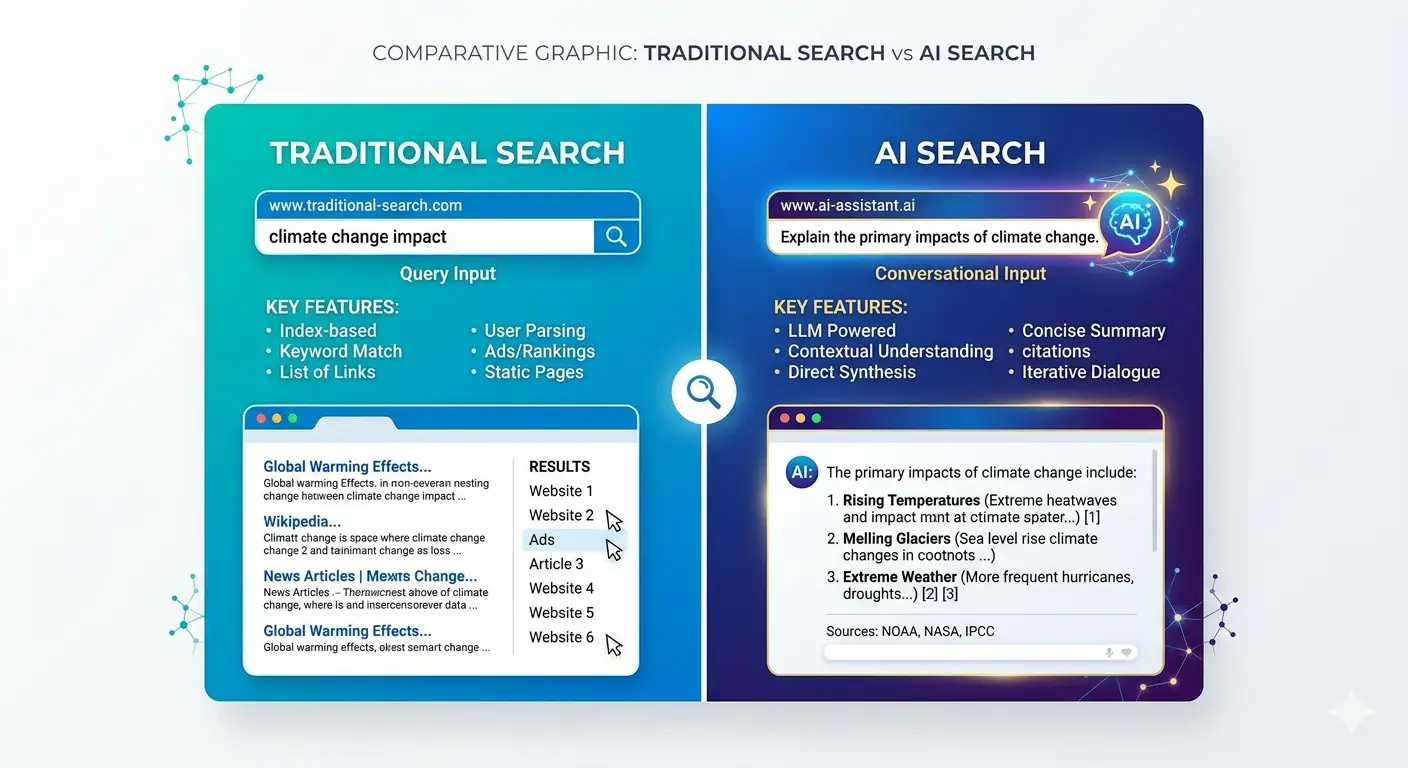
An answer engine is any platform that responds to a user’s question with a direct, conversational answer — rather than a list of links to go and find the answer yourself.
You already use answer engines every day. Examples include:
- ChatGPT (OpenAI)
- Google AI Overviews (the AI-generated summary now appearing above organic results on Google)
- Perplexity AI
- Microsoft Copilot (integrated into Bing)
- Apple Intelligence and Siri’s upgraded search
- Meta AI (built into WhatsApp, Instagram and Facebook)
When you type “What’s the best way to market a small business on a tight budget?” into ChatGPT or Perplexity, you don’t get ten blue links. You get an answer. A synthesised, confident, immediate answer — often without you ever visiting a single website.
That is the answer engine. And it’s where an enormous and rapidly growing share of search behaviour is now happening.
So What Is AEO — Answer Engine Optimisation?
Answer Engine Optimisation (AEO) is the practice of structuring your website content so that AI-powered answer engines can find it, understand it, and use it as the source of their answers.
Just as traditional SEO is about ranking on Google’s results page, AEO is about being the source that AI engines quote, reference, or summarise when someone asks a question relevant to your business.
In other words: if ChatGPT answers a question about web design agencies in the UK, the goal of AEO is to make sure that answer is built on your content — or better yet, mentions you by name.
How Is AEO Different from SEO?
They are complementary, not competing — but they require different approaches.
| Traditional SEO | AEO | |
|---|---|---|
| Goal | Rank on page 1 of Google | Be the source AI engines cite |
| Format | Long-form pages, backlinks, keywords | Clear Q&A structure, concise answers, authority signals |
| User behaviour | User clicks a link and visits your site | User gets an answer without necessarily clicking anything |
| Success metric | Rankings and organic traffic | Brand mentions, citation in AI responses, featured snippets |
| Speed of change | Gradual | Accelerating rapidly right now |
The critical insight is this: SEO gets you found. AEO gets you trusted.
When an AI engine cites your business as the answer to someone’s question, it is the most powerful form of third-party endorsement available. You’re not competing for attention — you’ve been selected as the authority.
Why Does AEO Matter for Small Businesses Right Now?
Here’s the uncomfortable truth: most of your competitors have never heard of AEO.
Which means right now — in mid-2025 — is the best possible time to build your presence in AI-generated answers. The landscape is not yet crowded. The businesses that move first will be the ones that AI engines learn to trust and reference consistently.
Consider a few numbers that should make this very real:
- Google AI Overviews now appear on over 50% of Google searches in the US and are rolling out aggressively across the UK and Europe.
- ChatGPT processes over 1 billion searches per day — more than Bing.
- Perplexity AI grew from 2.5 million to over 100 million monthly users in under 18 months.
- A significant portion of users — particularly 18–35 year olds — now go directly to AI tools instead of Google for research, recommendations, and service comparisons.
Your future customers are asking AI engines questions like:
“Who are the best web design agencies for small businesses in Wolverhampton?”
“How do I know if my business needs a rebrand?”
“What should I look for in a digital marketing agency?”
If your content doesn’t answer those questions clearly and authoritatively, you will not be part of that conversation.
How Do You Optimise for Answer Engines?
AEO is built on several principles that differ meaningfully from traditional SEO. Here’s what actually works:
1. Write in Questions and Answers
Structure your content around the exact questions your target customers are asking. Use question-based headings (like the ones in this very article). AI engines are trained to match questions with content that directly addresses them — so if you want to be the answer, write like you’re answering.
2. Be Concise and Direct at the Start
After each question or section heading, lead with a clear, direct answer in the first 1–2 sentences. AI engines pull the clearest, most direct answer they can find. Don’t bury your point in three paragraphs of context.
3. Build Topical Authority
AI engines don’t just look at individual pages — they assess the overall depth of knowledge a website demonstrates on a topic. If you want to be the authority on local SEO for UK small businesses, you need multiple pieces of content covering that topic from different angles, not just one page.
4. Earn Trust Signals
AI engines prioritise sources that other credible sources reference. This means backlinks still matter — but so do mentions, citations, case studies, and client testimonials that demonstrate real-world results. Your reputation online is a key signal.
5. Structured Data (Schema Markup)
Adding FAQ schema, HowTo schema, and Organisation schema to your website makes it significantly easier for AI engines to parse and use your content. This is a technical step, but an important one.
6. Stay Consistent Across Platforms
AI engines build their understanding of your brand from multiple sources — your website, your Google Business Profile, LinkedIn, reviews, press mentions. Consistent, accurate information across all of these strengthens your authority signal.
Does AEO Replace SEO? No. Here’s Why.
SEO is not dead — but it is evolving, and the businesses that treat it as a static checklist will fall behind.
Think of it this way: SEO builds the road. AEO makes sure AI engines know your business is at the destination.
You still need well-structured pages, strong technical foundations, quality backlinks, and relevant keywords. But layered on top of that, you now need content that is specifically designed to be understood, trusted, and cited by AI systems.
The two work together. An AEO-first content strategy that also follows SEO best practices is the most powerful digital approach available to small businesses today.
What Should You Do Next?
If you’re a small business owner and this is the first time you’ve heard of AEO, don’t panic — but don’t wait either.
Here’s a simple starting framework:
- Audit your existing content — Is it structured around questions? Does it answer those questions clearly and directly?
- Identify the top 10 questions your ideal client asks before hiring a business like yours, and create dedicated content for each one.
- Claim and optimise your Google Business Profile — it’s a key trust signal for both local SEO and AI engines.
- Add FAQ sections to your key service pages with schema markup.
- Publish consistently — AI engines favour sources that demonstrate ongoing expertise, not just one-off posts.
Frequently Asked Questions About AEO
What does AEO stand for? AEO stands for Answer Engine Optimisation. It is the practice of optimising your digital content to be surfaced and cited by AI-powered answer platforms such as ChatGPT, Google AI Overviews, and Perplexity.
Is AEO the same as GEO? They are closely related. GEO (Generative Engine Optimisation) is another term used for the same discipline — optimising content for generative AI search tools. AEO and GEO are often used interchangeably, though AEO tends to focus on structured Q&A content while GEO can encompass broader generative AI visibility strategies.
How long does AEO take to show results? Because AI engines draw on existing indexed content and trust signals, AEO is partly dependent on your current SEO foundation. Businesses with established domain authority may see results within weeks of implementing AEO best practices. For newer websites, it should be treated as a 3–6 month investment alongside a consistent publishing strategy.
Can small businesses compete with large brands in AEO? Yes — and this is one of the most exciting aspects of AEO. AI engines are not purely influenced by budget or brand size. They reward clear, authoritative, well-structured answers. A small agency with genuinely helpful, well-organised content can absolutely out-rank a large corporate competitor in AI-generated responses.
Final Thought
The businesses winning online in 2026 and beyond won’t just be the ones with the most backlinks or the highest ad spend. They’ll be the ones that AI engines have learned to trust — the ones whose content consistently and clearly answers the questions their customers are asking.
AEO is not a trend to watch. It’s a shift that is already happening, and the window to get ahead of your competitors is open right now.
At HusQuay, AEO is built into everything we do — from how we structure our clients’ websites to the content strategies we build for them. If you’d like to understand how your business could show up in AI-generated search results, we’d love to talk.
👉 Book a free strategy call with the HusQuay team
HusQuay is a digital growth agency helping small businesses across the UK, USA, Australia, and Canada build websites, brands, and digital systems that create measurable results. Based in Wolverhampton, UK.