
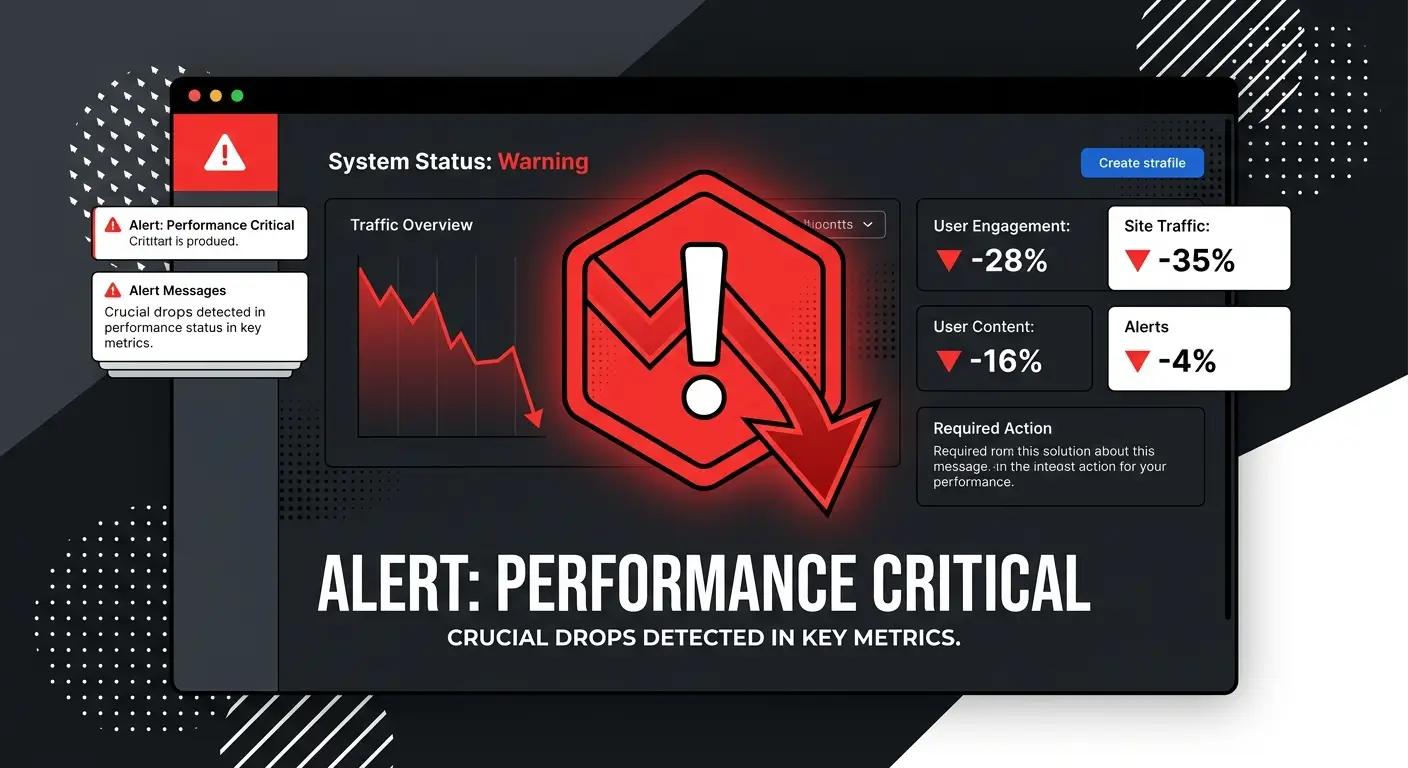
Most business owners with an underperforming website assume it’s neutral — a box ticked, a presence maintained, something that isn’t helping much but isn’t hurting either. That assumption is almost always wrong. A website that doesn’t convert isn’t sitting quietly in the background. It’s actively damaging your reputation every time a potential customer visits, loses confidence, and clicks away to a competitor. Here are the seven most common signs that your website is costing you business — and what each one tells you about what needs to change.
A website that doesn’t work for your business is not the same as having no website. In some ways it’s worse — because it absorbs the cost of hosting, maintenance, and the mental energy of thinking you’ve handled your digital presence, while delivering none of the return.
Run through the following seven signs honestly. The more of them that apply, the more urgently your website needs attention.
Sign 1: It Takes More Than Three Seconds to Load
Speed is not a technical nicety — it’s a commercial necessity.
Research consistently shows that over half of mobile users abandon a website that takes longer than three seconds to load. Every additional second of load time reduces conversions by approximately 7%. On mobile, where the majority of your visitors are arriving, the standards are even less forgiving.
Go to pagespeed.web.dev right now and test your website. Google will give it a score out of 100 and tell you specifically what’s causing slowness. A score below 50 on mobile is a serious problem. Below 70 is worth addressing.
The most common causes of slow load times are uncompressed images, cheap shared hosting, poorly coded themes, and too many third-party scripts running on every page. Most of these are fixable without rebuilding the entire site — but they require someone who knows what they’re looking at.
What it’s costing you: Every slow-loading page is a visitor who left before they saw your offer, your credibility signals, or your call to action. They didn’t bounce because they weren’t interested. They bounced because you made them wait.
Sign 2: It Looks Wrong on a Phone
More than 60% of web traffic globally now comes from mobile devices. In the UK, for most local service businesses, that figure is even higher — many see 70–80% of their visitors on mobile.
If your website was built more than five years ago, or built cheaply by someone who didn’t prioritise mobile, it may technically be “responsive” while still delivering a frustrating mobile experience: text that’s too small to read without zooming, buttons too close together to tap accurately, forms that don’t work properly on a touchscreen, images that overflow the screen.
Test it yourself. Open your website on your phone right now and try to do what a new visitor would do — find out what you do, read about your services, and contact you. Count how many times you pinch to zoom, how many times a tap doesn’t register, how many times you have to scroll sideways.
What it’s costing you: A mobile visitor who has a poor experience doesn’t complain. They leave. They tell nobody. They just quietly use your competitor instead.
Sign 3: There’s No Single Clear Call to Action
Visit your homepage. What is the one thing you want a visitor to do?
If your homepage has five buttons — “Learn more,” “View services,” “Meet the team,” “See our portfolio,” and “Get in touch” — you’ve given visitors five decisions to make when they should be making one. Confused visitors don’t convert. They leave.
Every page on your website should have one primary goal and one primary call to action that guides the visitor toward it. On a service business homepage, that’s almost always some version of “book a call,” “get a quote,” or “contact us.” Everything else on the page exists to build enough trust and clarity to make that single action feel like the obvious next step.
What it’s costing you: Visitors who were genuinely interested but had no clear direction. They visited, they read, they weren’t sure what to do, and they closed the tab.
Sign 4: You Can’t Remember the Last Time You Updated It
A website that hasn’t been updated in 12 months sends a quiet signal to every visitor: this business isn’t active, engaged, or growing.
It doesn’t matter that you’re busier than ever, serving more clients than ever, and have a waiting list. If your last blog post is from 2022, your team photo includes people who left, your case studies are all from three years ago, and your services page doesn’t reflect what you actually offer — your website is telling a different story than your business.
Beyond credibility, freshness matters to Google. Regular, relevant updates signal an active, authoritative site. A neglected site loses ground in search rankings over time, even if everything else stays the same.
What it’s costing you: Credibility with every visitor who notices the staleness, and ranking position with every competitor who’s publishing consistently while you’re standing still.
Sign 5: Your Bounce Rate Is Above 70%
Bounce rate measures the percentage of visitors who arrive on a page and leave without taking any action — no click, no scroll to another page, no form submission, nothing.
A bounce rate above 70% for a service business website is a signal worth investigating. It means the majority of people who find you are deciding, quickly, that you’re not what they’re looking for — or that what they find doesn’t match what they expected.
Common causes: a mismatch between the search term or ad that brought them there and what they see on arrival, a slow load time, an immediately off-putting design, confusing navigation, or content that doesn’t quickly answer the question “can this business help me?”
You can find your bounce rate in Google Analytics (free). If you don’t have Google Analytics installed on your website, that’s a sign in itself.
What it’s costing you: A significant proportion of the visitors you’re already attracting — paid or organic — who are leaving before they’ve even engaged.
Sign 6: You Can’t Find Yourself on Google
Search for the service you offer in your town. Does your business appear?
Try a few variations: your exact business name, your service plus your city, your service plus “near me.” If you’re struggling to find yourself — or if you appear on page 2 or 3 for searches you should be winning — your website is failing at the one job that matters most before any visitor can even arrive.
Poor search visibility has two main causes: weak on-page SEO (your pages don’t communicate clearly to Google what you do and where you do it) and low domain authority (Google doesn’t yet trust your site enough to rank it above more established competitors).
Both are fixable. Both take time. And neither will fix itself without deliberate action.
What it’s costing you: Every potential client who searched for what you do, found your competitor on page one, and never knew you existed.
Sign 7: You’ve Never Received an Enquiry From It
This is the most conclusive sign of all — and the most commonly ignored.
Business owners sometimes rationalise this: “most of my work comes through referrals,” “my clients don’t really use the internet to find us,” “our industry just doesn’t work that way.”
Sometimes those rationalisations are true. But more often, they’re a story built around the absence of evidence — because a website that has never generated a single enquiry has never been properly evaluated, optimised, or taken seriously as a business tool.
A professional website for a service business, built and maintained properly, should generate enquiries. Not immediately, not without SEO, and not without a reason for visitors to trust you — but consistently, over time. If yours has never done this, the question isn’t whether the website needs attention. It’s how much.
What it’s costing you: Every client who found you online, visited your website, decided it wasn’t convincing enough to contact you, and went elsewhere. You’ll never know how many that is. Which is precisely the problem.
What to Do If Several of These Apply
Start with the ones that are costing you the most right now.
If your site is slow, fix the speed first — it affects every other metric. If your mobile experience is broken, fix that next — the majority of your visitors are on their phones. If there’s no clear call to action, add one today — this is a change you can often make yourself.
For the deeper issues — poor search visibility, chronically low conversion, outdated design and content — these usually require a proper rebuild or a significant overhaul rather than incremental fixes. The question to ask is: what would one additional client per month be worth over the next year? For most service businesses, the answer is significantly more than the cost of rebuilding the site properly.
Frequently Asked Questions
How do I know if my website is costing me customers? The clearest signs are: a load time over three seconds, a poor mobile experience, no clear call to action, a bounce rate above 70%, inability to find your business on Google, outdated content, and — most tellingly — never having received an enquiry from your website. Any combination of these is a signal that your website is losing business rather than generating it.
What is a good bounce rate for a small business website? For a service business, a bounce rate of 40–60% is considered reasonable. Above 70% is a warning sign that visitors are not finding what they expected when they arrive, or that the page isn’t compelling enough to encourage further exploration. Bounce rate alone doesn’t tell the whole story — it should be viewed alongside time on page and conversion rate.
How do I check my website’s loading speed? Go to pagespeed.web.dev, enter your website URL, and run the test. Google provides a score out of 100 for both mobile and desktop, along with specific recommendations for improvement. Aim for a mobile score above 70. Below 50 is a significant commercial problem.
Can I fix my website myself or do I need a developer? Some improvements — adding or clarifying a call to action, updating content, compressing images — can be made without a developer if you have access to a content management system like WordPress. Speed issues, structural SEO problems, mobile layout problems, and conversion rate issues typically require professional input to fix properly and permanently.
How long does it take for a new or rebuilt website to start generating enquiries? A newly built website with proper on-page SEO in place typically starts seeing organic traffic growth within 2–4 months, with meaningful lead generation following as the domain builds authority. Paid traffic (Google Ads, for example) can drive enquiries from day one if the landing page is built to convert. SEO-only strategies typically require 4–12 months of consistent content publication to generate reliable organic enquiries.
How much does it cost to fix a website that isn’t converting? This depends on the root cause. Speed and basic SEO fixes can often be done for £300–£800. A full design and conversion optimisation overhaul typically costs £1,500–£5,000. A complete rebuild for a service business starts from £2,500. In most cases, the cost of fixing or rebuilding is recovered quickly by the additional enquiries the improved site generates.
Final Thought
A website that isn’t working is not a neutral asset. It’s a leaking bucket — draining the credibility and revenue that should be flowing into your business every time a potential customer finds you and decides, within seconds, that you’re not worth their time.
The good news is that the seven signs above are all diagnosable, all measurable, and all fixable. The first step is simply being honest about how many of them apply.
At HusQuay, we build websites that are designed from the ground up to convert visitors into enquiries — fast, mobile-optimised, clear in their purpose, and built to rank. If you’ve recognised more than a couple of the signs above, it’s worth a conversation.
👉 Book a free website review with the HusQuay team
HusQuay is a digital growth agency helping small businesses across the UK, USA, Australia, and Canada build websites, brands, and digital systems that create measurable results. Based in Wolverhampton, UK.